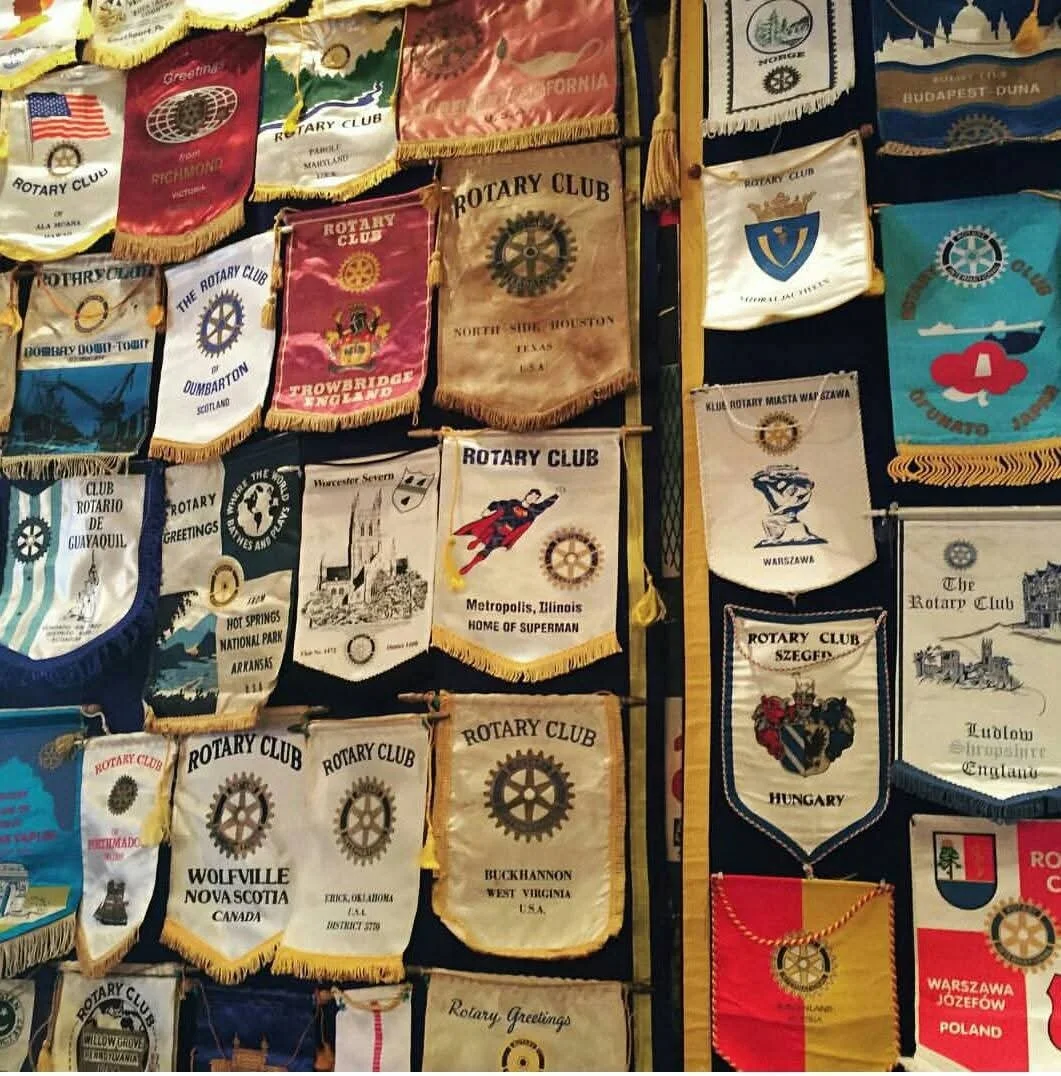
For more than a century, Rotary clubs around the world have exchanged these small, colourful, and often beautifully crafted banners as symbols of fellowship, identity, and global connection.
These banners, often proudly displayed in meeting rooms or kept as treasured mementos, represent a long-standing Rotary tradition rooted in friendship and international goodwill. But as Rotary continues to modernise, digitalise, and adapt to new generations of members, one question quietly emerges: Is the club banner still relevant, or has it become just another Rotary relic destined for the archive box or dare I say it the rubbish bin?
A Brief History of Rotary Banners
The custom of exchanging club banners dates back to the early 20th century. As international travel became more accessible, Rotarians visiting clubs abroad sought meaningful ways to commemorate these encounters. A banner bearing a club’s name, colours, motto, and local symbolism became the perfect token.
By the 1950s and 1960s, banner exchanges were pretty widespread. District Governors returned from club visits with suitcases full of banners! (Thankfully i’ve only been given 3 banners in my current year as DG)
Meeting rooms hung them proudly along the wall, forming a colourful tapestry of Rotary’s global footprint. Banners were not simply decorations, they were storytelling tools. Each one reflected the character, culture, and spirit of the club that created it and they were, or to some degree are tangible reminders that Rotary extended far beyond one town, district, or country. For many clubs, designing a banner was an act of pride a chance to showcase local history, industry, or iconic landmarks and for visiting Rotarians, presenting their club’s banner was both a gesture of respect and a reminder of the shared values that bind us.
But Are Banners Still Relevant Today?
Fast forward to today’s Rotary. The world has changed. Communication is instant and digital. Some members are younger, busier, and less inclined toward collecting memorabilia. Rotary itself encourages innovation and flexibility. The question becomes unavoidable:
Are club banners a meaningful tradition that strengthens Rotary identity, or have they become nostalgic novelties, the Rotary equivalent of collecting a collectable that doesn't spark joy anymore?
On one hand, many clubs no longer display banners regularly. Some have entire storerooms filled with dusty collections from decades past. Budget-conscious clubs question the cost of printing them. Environmentally conscious members question the need for more “stuff.”
On the other hand, banners remain one of the few tactile, personalised symbols of Rotary’s internationality. In an era of Zoom meetings and digital engagement, a physical object exchanged between clubs can feel refreshingly authentic. For visiting Rotarians, handing over a banner can still spark conversation, connection, and pride.
Tradition vs. Transformation
As Rotary strives toward long-term growth and relevance, traditions like the banner exchange inevitably come under review. But traditions can evolve rather than disappear. Some clubs now design minimalist or eco-friendly banners made from recycled materials. Others create digital banners, high-resolution designs shared via email or over social medis, reducing waste while maintaining the spirit of exchange.
My question isn't simply “Should we keep banners?” but rather is it a cherished emblem of fellowship, or a quaint tradition ready for retirement?
Is it a symbol of global unity, or just another trinket cluttering our cupboards?
The answer may be different for each club. But as Rotary continues balancing innovation with heritage, this small piece of fabric invites us to ask a bigger question:
What traditions really truly matter in Rotary now, and how do we honour our past without being limited by it?
Article by Evan Burrell